

🦇🍂 A family, a house, a mystery without end
📜 Nathaniel Hawthorne: A Life Between Guilt and Puritanism
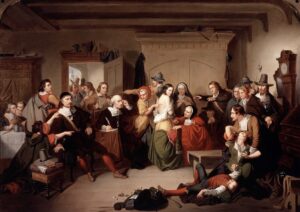
Nathaniel Hawthorne was born on July 4, 1804, in Salem, Massachusetts — a town still shadowed by the echoes of the witch trials of 1692. The streets, the houses, even the air itself seem to preserve the whispers of those condemnations. And in the Hawthorne family history lies a guilt that feels inherited: one of Nathaniel’s ancestors, John Hathorne, was among the judges who sent the “witches” to their deaths.
Hawthorne grew up with that ghost at his back. It wasn’t merely a historical fact but a moral wound — a sin that, though not his own, he felt bound to atone for. From this burden was born his obsession with guilt and redemption and with that fragile boundary where the human soul confronts its own sin.
After studying at Bowdoin College in Maine, Hawthorne moved between modest jobs — proofreader, customs clerk — yet his true calling was writing. In his tales and novels, he probed deep into the folds of Puritan New England, where virtue and sin, appearance and truth, law and injustice mingled like shadows on glass.
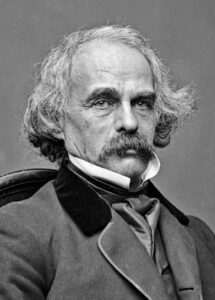
In 1851, he published The House of the Seven Gables, perhaps his most emblematic novel. Within its pages, the ancient mansion is not merely a place but a character: it guards memories, guilt, and family curses. Hawthorne wove Gothic atmosphere with psychological insight, turning the house into a metaphor for the mind — and for history — that continues to inhabit those who inherit it.
With his pen, Hawthorne became an investigator of the soul. Beneath the plots of his books, one question always lingers — the one that haunted him: Can we ever free ourselves from the weight of our ancestors? In his writing already vibrates a theme that American literature would only later begin to explore — that of generational trauma, of guilt that becomes body, memory, destiny.
🏚️ The Stifling Walls of a Dark House
There is a house, at the imaginary number of a Puritan street in New England, that seems to breathe with its inhabitants. Its walls creak like bones, its gables gaze upon the town with the dull eye of a culprit who has never confessed. Inside those walls, time does not pass — it stagnates.
It is here that Nathaniel Hawthorne, in 1851, sets The House of the Seven Gables — a novel that begins like a Gothic tale but, read today, reveals itself as a true literary cold case.
Beneath its thick air of dust and superstition hides a crime: a murder of property and power, a crime without expiry, passed down through generations. And as in the best true-crime stories, the real guilt lies not only in the blood spilled, but in the moral poison.

⚖️ The Pyncheon Case: The Origin of a Curse
It all begins with an act of injustice. Colonel Pyncheon, founder of the dynasty, deceitfully seizes the land on which the house stands, having its rightful owner, Matthew Maule, condemned to death for witchcraft — a convenient accusation to remove a man who stood in the way of his ambition.
Before dying, Maule utters a curse: “God will give him blood to drink.”
A phrase that, read today, sounds like a dark law of retribution — blood calls for blood. Indeed, soon after the house’s inauguration, the colonel is found dead, his beard soaked with blood, slumped over his desk. The case is closed as a “natural death,” but the shadow of crime remains. It is the first clue. The first autopsy report.
From then on, the Pyncheon family lives trapped in a perpetual crime scene. Each descendant seems to reenact a role in a script already written: greed, guilt, physical and mental decay. Hawthorne shapes the house as a diseased body — with wooden veins, shuttered lungs, and light that never enters — an organism that somatizes its curse and turns it into a chronic symptom.

🧬 The “Moral DNA” of a Family
Today, we might call it intergenerational trauma. In the nineteenth century, Hawthorne lacked the language of modern psychiatry, yet in his own way, he understood its mechanisms. The Pyncheons are a pathological family, afflicted by a moral illness transmitted like a recessive gene. Each character displays a different symptom:
• Hepzibah, the elderly spinster who lives secluded in the house, embodies depression and agoraphobia; her physical “blindness” is also moral blindness.
• Clifford, her brother, is the most fragile victim: unjustly accused of a crime, he has spent years in prison. He is a wreck of trauma, showing symptoms we would now call post-traumatic — dissociation, apathy, fear of the world.
• Phoebe, the young niece, represents the possibility of healing: empathetic, alive, she is the first to break the family’s toxic cycle.
But the house — like a chronic patient — resists treatment. Hawthorne seems to suggest that guilt cannot be erased: it is inherited, embodied and makes one ill.

🔍 True Crime Ante Litteram
Reading The House of the Seven Gables feels like leafing through a nineteenth-century crime dossier: a cold case never solved, where the line between culprit and victim blurs. Hawthorne doesn’t merely tell a Gothic story — he investigates. He examines the evidence, questions the witnesses, re-reads the scene. Every element of the house becomes a piece of material proof:
• The key that no longer opens the colonel’s chamber
• The portrait that seems to conceal a secret (perhaps the real will)
• The garden where the spilled blood seems to keep feeding the earth
They are details no modern crime reporter would overlook. Hawthorne arranges them with the precision of an investigator, but instead of fingerprints he finds moral prints.
🧩 Guilt, Paranoia and Madness
In a family scarred by a shocking event — real or symbolic — pathological dynamics can take root, resembling a clinical case. Through his story, Hawthorne seeks, in line with his convictions, to portray guilt not only as a moral fact but as a hereditary psychic disease.
Thus the house becomes a metaphor for a troubled mind:
• The locked rooms as repressed memories
• The gables as shadow zones of the unconscious
• The portraits as hallucinations of a guilty conscience
Clifford, above all, could today be read as a man suffering from post-traumatic stress disorder. His hypersensitivity, his fear of noise, his inability to face the outside world — everything speaks of a wounded psyche.
Hepzibah, meanwhile, shows the marks of anxious depression: she lives in shame, in withdrawal, fixated on the past. The Pyncheon family doesn’t need an exorcism — it needs therapy.

🩸 The Weight of an Inheritance
For Hawthorne, every dynasty that guards a secret sickens from its own silence. The theme of hereditary guilt runs through all of American literature, but in Hawthorne it takes on an almost clinical shape. It is an inherited obsession, a pathology of lineage.
Faced with the question of whether evil is innate or learned, Hawthorne answers — stubbornly, in his own way — that it is transmitted. Not as a biological destiny, but as moral memory. The house — symbol of family inheritance — is the place where guilt never dies but is handed down like a dormant virus.
It is, after all, the same dynamic sometimes found in real families marked by violence, loss, or unresolved mysteries: trauma becomes an inherited story, a silent language each generation repeats without knowing it, feeling instead that their family history begins again each time — moving in an endless, circular motion.
🪞The Pyncheon Curse as a Mirror of Society
Behind the story of a family haunted by an ancient sin, Hawthorne glimpses something larger: a pathology of the collective soul. The Puritan society that judges and condemns, hiding behind morality and respectability, becomes the true character of the novel.
The Pyncheon curse doesn’t belong to one bloodline alone — it echoes through a nation that built its destiny on guilt and the shadow of hypocrisy. (It’s the same idea that animates The Scarlet Letter) In the house with its seven gables — its turrets, dark corridors, and rooms where the past still breathes — Hawthorne portrays America of that age, trapped between its hunger for purity and the memory of an unjustifiable violence. Beneath the façade of respectability, secrets stir: silences, guilts no one dares name. Hawthorne invites us to look beyond the surface — to the place where virtue wears a mask and sin disguises itself as duty.

🕰️ Time as Evidence
One of the most striking features of the novel is its treatment of time. It does not flow — it stagnates, coils in on itself. It is as if the house had remained frozen at the moment of the first crime. In true-crime logic, this corresponds to a contaminated scene: until the truth is spoken, the evidence remains active, the case unresolved.
Only when Phoebe and young Holgrave — a descendant of Maule, the ancient victim — meet, does the truth find its way out. Their symbolic union is the reconciliation of victim and perpetrator, the only way to break the cycle. A kind of integration of trauma: to recognize evil in order to disarm it.
🕵️♂️Hawthorne, Investigator of the Soul
Hawthorne could have signed some remarkable investigative reports: he had an eye for detail, a sensitivity to moral ambiguity and the gift of reading the psyche beneath appearances. In the novel, his writing oscillates between forensic observation — every object a clue — and psychological intuition — every gesture a symptom.
In this sense, The House of the Seven Gables is a perfect example of inner true crime: it is not concerned with discovering who killed, but with understanding what kills. And the answer is clear: suspicion, shame, the inherited sense of guilt.
👻A Ghost Story Without Ghosts
Curiously, in a book that seems so Gothic, there are no actual ghosts.
The specters are inner ones: memories, grudges, remorse.
Hawthorne does not believe in supernatural fear, but in moral fear. It is conscience that haunts the house. As happens in real life for those who survive tragedy and live for years with the uneasy sense of having received an undeserved reprieve, the Pyncheon family is haunted by presences that cannot be expelled — because they dwell within.
❤️🩹As the House, So Those Who Live in It
Read through clinical eyes, the novel is also a meditation on the somatization of guilt. The Pyncheons fall physically ill from their own history: they become rigid, pale, anemic. The house itself is described as a suffering body — and not by chance, when the truth emerges, it seems to breathe again.
It is a powerful image: healing as confession. As long as truth remains hidden, everything rots — the house, the blood, the mind. Only the word — the telling of the true story, however painful — can heal.

✒️ The Silence That Destroys
To reread The House of the Seven Gables today is to face a theme still painfully current: the destructive power of family silence. Every family, real or literary, guards a secret — but it is in the keeping of silence that it sickens. For Hawthorne, guilt is a narrative virus: it passes from mouth to mouth, generation to generation, until someone finds the courage to speak it aloud.
Thus, the novel is not merely the story of a haunted house, but the metaphor of a truth demanding to be told. And in this, The House of the Seven Gables stands as a perfect meeting point between literature and true crime: an investigation into guilt as inheritance, into crime as family language and into the spoken word as the only possible form of justice.
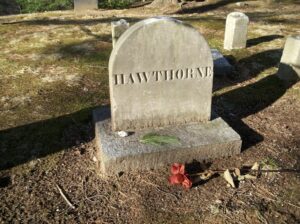
“I am trying to resume my pen … Whenever I sit alone, or walk alone, I find myself dreaming about stories, as of old; but these forenoons in the Custom House undo all that the afternoons and evenings have done. I should be happier if I could write.” N.H.
Samanta Sforna – All rights reserved.