

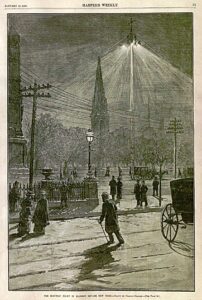
New York, 1889 – The city that never sleeps was beginning to light up. But on that day, the glow of progress turned electric blue and the air filled with acrid smoke.
The City Suspended in Wires
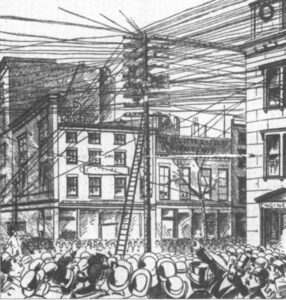
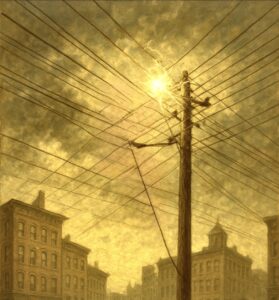
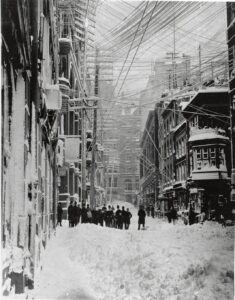
It was the autumn of 1889, and Manhattan already looked like a city projected into the future — pulsing with noise, carriages, steam, and the first threads of electricity. Above the heads of passers-by, more than ten metres high, an intricate network of telegraph and power cables crossed every street, like a web of metal and tension.
The electric revolution had already conquered that part of the world, yet no one truly knew how to manage it. Among that tangle of wires worked John Feeks, twenty-seven years old, a lineman for the Western Union Telegraph Company. It was a new and dangerous profession, hardly recognised at the time: climbing poles, replacing lines, repairing faults while balancing between wind and emptiness. Electricity then was not used with much awareness. Each line carried a different voltage, often uninsulated and companies competing for business shared the very same poles.
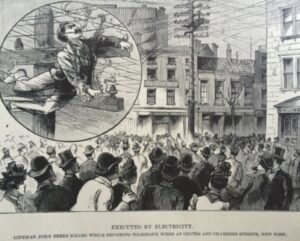
On 11 October 1889, around midday, Feeks climbed a pole on Chambers Street, in the heart of Downtown Manhattan. His task was simple — to move a telegraph wire. Below, life went on as usual: ladies with parasols, errand boys, children running between the carriages. No one could know that, within moments, they would witness one of the most shocking accidents in the history of electricity.
The War of the Currents
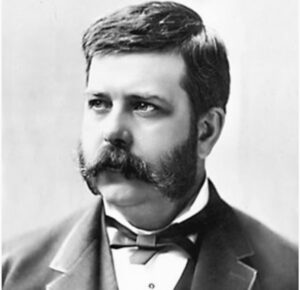
To understand what happened to John Feeks, we must go back a few years. At the end of the nineteenth century, two visions of the modern world collided in laboratories and on city streets: Thomas Edison, champion of direct current (DC), and George Westinghouse, who, alongside Nikola Tesla, promoted alternating current (AC). The first was stable and predictable, but could travel only short distances; the second, more efficient, could power entire cities — though at the cost of far higher voltages.
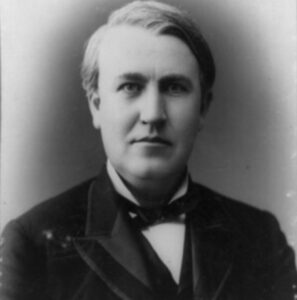
Edison, having built an empire upon direct current, was unwilling to yield ground. He launched a full-scale propaganda campaign, publicly demonstrating the “dangers” of alternating current — electrocuting animals to prove his point, and declaring that AC was fit “only to kill, not to illuminate.” He even coined a grim but effective phrase: “To Westinghouse” — meaning to be killed by alternating current. And when, only a few years later, Feeks was electrocuted beneath the wires of Manhattan, Edison had his perfect example.
The Incident: A Flash Among the Wires
It was a clear day, sunlight glinting off the windows of the tall buildings. Feeks was high atop the pole, fastening what seemed an innocuous telegraph line. In truth, some nearby electric wires belonged to the United States Illuminating Company, which used high-voltage alternating current to power the city’s lamps. A short circuit, several blocks away, had caused one of those AC lines to come into contact with a telegraph wire. Unaware, Feeks reached out and grasped the wrong one.
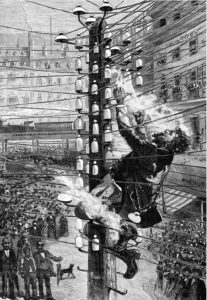
There was a flash. A sharp crack — then the smell of ozone and burning flesh. His body stiffened instantly; his right arm locked in a death grip, his head thrown back. The current entered through his right hand and exited through his left boot, passing through his entire body in less than a heartbeat. Feeks died instantly, yet his body remained hanging among the wires, trapped within the electric web. Below, an ever-growing crowd stared in horror: his body smouldering, blue sparks darting from his chest, droplets of blood falling to the street.
A reporter from The Wellsboro Agitator wrote: “The body sizzled like meat upon the coals. Blood dripped upon the spectators and no one dared to move.”
The fire brigade arrived within minutes, but none could climb — to touch the wires meant certain death. Only after nearly an hour, when the power was finally cut, were they able to retrieve the charred remains. The face was half-destroyed; the hands fused into a clenched mass of flesh and metal. That day, New York saw the dark side of progress.
The Media Echo and the Electric Fear
The death of John Feeks spread across the nation within hours. Newspapers screamed from their front pages: “Murdered by Electricity!” Public opinion was horrified. For the first time, a technological death had unfolded before thousands of witnesses. Edison swiftly seized upon the event as living proof of the danger of alternating current. In the weeks that followed, civic committees demanded that overhead lines be removed or buried underground.
Some newspapers openly spoke of industrial murder. The fear grew so strong that, only months later, the State of New York introduced the electric chair as a new method of execution — believed at the time to be “more humane” than hanging. People came to think that death by electricity would be instantaneous and painless — science used to make punishment “more civilised.” Yet it was a cruel paradox: the very same alternating current that had killed John Feeks by accident now became the chosen means to kill by law.
His accident, printed and retold in every paper, transformed the wonder of progress into fear and awareness. Out of that death was born a new idea — that modernity must learn to protect humankind from its own inventions. It was the beginning of the concept of electrical safety, and of an ethical reflection on the price of progress.
Inside the Body: The Process of Electrocution
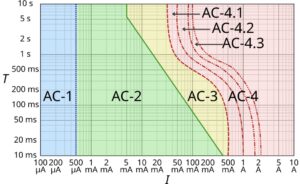
What really happens when the human body meets electricity? The body is a natural conductor: blood, muscles and nerves carry electrons almost like wires. When a high-voltage current passes through the tissues, it follows the path of least resistance — usually along blood vessels and nerves. In Feeks’s case, his bare hand and his iron-studded boot formed two perfect poles. The current travelled along a right-to-left axis, crossing the heart.
An electric impulse of that magnitude induces immediate asystole or fulminant ventricular fibrillation. The nervous system shuts down; the muscles convulse violently; breathing ceases. But it is not only a matter of electricity — the passage of current also generates heat, through the Joule effect. The tissues can reach temperatures of several hundred degrees within moments. Cellular proteins coagulate, cells burst, and skin carbonises.
Electrical burns are deep and deceptive: small on the surface, devastating within. According to the doctors of the time, Feeks presented a “thermal section of the face and chest,” suggesting a current that traversed the body, exiting through the leg. A death instantaneous — yet not painless, at least not in the memory of those who watched.
Why We Say “Electrocuted”
The word folgorazione comes from the Latin fulguratio, derived from fulgur — “lightning”, the flash that tears through a storm. In ancient times, to be “struck by lightning” was to be touched by the gods: a rare, sudden act of divine wrath — an instant contact between heaven and earth. When electricity entered the modern world, language naturally borrowed that same image to describe those struck by a man-made thunderbolt.
To be electrocuted meant to be touched by the “artificial lightning.” Thus the word unites two eras — the age of myth and the age of science — and preserves within it the same sense of overwhelming power, of light that wounds. In a way, John Feeks was the first man to be “struck by lightning” in the industrial world — not by Jupiter’s hand, but by the new god of progress.
If It Happened Today: Nursing Management of an Electrocuted Patient
Let us imagine, for a moment, that John Feeks had not died instantly. How would a patient struck by high-voltage electricity be treated today?
The first rule for any rescuer is not to become a victim. Even in cases of electrocution, scene safety comes first: no one touches the casualty until it is certain that the electrical source has been disconnected.
If possible, the current is broken by moving the cable or source with an insulating material — dry wood, plastic, or rubber — and the emergency services (999 or 118) are called immediately.
At the scene, the sequence of nursing and emergency care follows a strict order:
• Assessment of the environment and request for power disconnection by electrical personnel
• Check of consciousness and breathing
• If the patient is unresponsive and in cardiac arrest, immediate cardiopulmonary resuscitation (CPR)
• Management of burns: cover with sterile dressings, without removing charred tissue or foreign bodies
• Immobilisation in the event of a fall from height — a frequent occurrence among line workers and electricians
In hospital, nursing care becomes multidisciplinary.
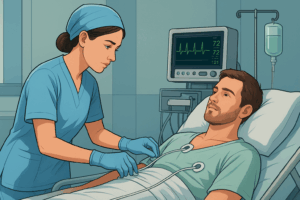
The patient is placed under continuous ECG monitoring for 24–48 hours, since serious arrhythmias can appear later.
Vital signs and oxygenation are monitored constantly.
Blood tests include CPK, myoglobin, and creatinine, to detect early signs of rhabdomyolysis or renal injury.
Generous intravenous fluid therapy is started, sometimes with urine alkalinisation to protect the kidneys.
Burns are treated with sterile dressings and adequate analgesia; infection is prevented; fractures or internal injuries from falls are carefully evaluated.
Yet care is not merely technical — it is relational and psychological as well. Those who survive electrocution often suffer nightmares, anxiety, or difficulty returning to work. Here, the nurse becomes the steady presence — coordinating priorities, observing for deterioration, and guiding the patient through a journey of physical and emotional reconstruction. It is the calm voice within the chaos — the one who transforms destructive energy into the possibility of life.
From Tragedy to Prevention
The death of John Feeks became a turning point in the history of regulation. Within a few years, New York authorities ordered the removal of overhead power lines and the separation of high-voltage from telegraph systems. The first urban electrical safety regulations were born, along with a new profession: the high-voltage technician.
In medicine, too, knowledge evolved. Doctors learned to recognise and treat electrical injuries, from resuscitation protocols to burn management guidelines. Every time a nurse or doctor today faces a case of electrocution, they are — in some sense — working in the long shadow of that tragedy of 1889.
Man Between Light and Shadow
When John Feeks’s body was finally lowered to the ground, New York fell silent. People looked upwards — towards those wires that, only the day before, had been symbols of progress, and now seemed like ropes of death. Within days, the tone of the newspapers had changed: from wonder to fear. Yet perhaps, in that suspended death, there was a deeper truth.
Electricity is neither good nor evil. It is pure power. It is up to humankind — through its hands, its tools, its ethics — to decide how that power is used. Today we live immersed in current: in the invisible filaments of Wi-Fi, in the cords of our devices, in the monitors of intensive care units. Electricity is everywhere — still one of the most extraordinary and deadly forces we know.
Perhaps, if he could speak, John Feeks would remind us that every spark of light has a price — and that behind each invention lies a body that has paid the cost of the experiment. And that behind every act of rescue, every illuminated screen, every heart brought back to life, there is always someone who — like him — once became the bridge between life and progress.
Samanta Sforna – All rights reserved.