

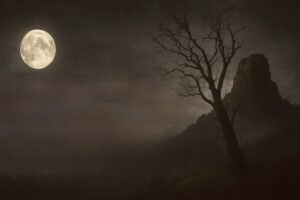
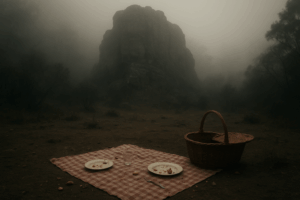
At first, it sounds like a news story. It’s Valentine’s Day, 1900. A group of schoolgirls from a Victorian boarding school in Australia set out for a picnic at the base of a rock formation known as Hanging Rock. The mood is light, the girls are laughing, the day is warm and bright. Then, in the silence of the bush, something happens. Three of them and a teacher wander off, climb the rocky slope, and vanish. No one ever sees them again.
📜 A Fact That Never Happened
It could be the beginning of an unsolved true crime. But the case never existed. It’s a perfect invention — an enigma created by Australian writer Joan Lindsay, who in 1967 published a novel destined to become a literary myth: Picnic at Hanging Rock. A story that reads like an impossible investigation, yet with every page reveals something deeper: mystery as a form of knowledge, unknowing as a kind of truth.
For years, readers believed the story was real. Lindsay wrote with the precision of a reporter — dates, testimonies, the detailed description of real places. The book begins with what feels like a statement of fact: “Valentine’s Day, 1900. Appleyard College, Victoria.” There is no hint that this might be fiction.
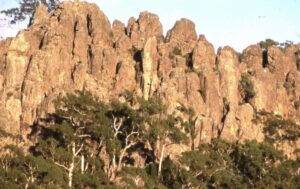
In 1960s Australia, still searching for a cultural identity of its own, the tale of a disappearance with no explanation set in an ancient, untamed landscape felt plausible — almost archetypal. Hanging Rock does exist, a volcanic monolith about an hour from Melbourne, with a presence at once majestic and menacing. Lindsay knew it well. She often said the rock had “a personality of its own, like a sleeping creature that still breathes.”
But in Picnic at Hanging Rock, the rock is not just a setting; it’s a threshold. Something opens. Something is lost. The girls who climb beyond the visible world don’t make a mistake — they cross into another order of being that reason cannot explain.
🕰️ The Woman Who Stopped Clocks
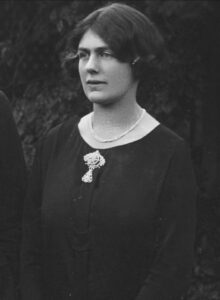
To understand Picnic at Hanging Rock, one must understand the woman who wrote it. Joan Lindsay was born in 1896 in Melbourne, into a cultivated family connected to art and literature. She studied painting, married an artist — Daryl Lindsay — and lived for decades at Mulberry Hill, a house surrounded by gardens and whispers. Legend has it that the clocks there often stopped for no apparent reason.
She didn’t find that strange. “Time,” she used to say, “ is not a straight line. It’s a spiral that sometimes folds back on itself.”
It was both a poetic statement and an artistic credo. Lindsay believed that art could open cracks in time, and that certain moments — the most intense, the most traumatic — could slip out of chronology, hanging suspended.
She wrote Picnic at Hanging Rock in just two weeks, at night, as if transcribing a dream already lived. The novel moves with the rhythm of a reverie: a world where time shatters, and logic quietly gives way, like a stone split by heat.
🪞Order and Chaos
Appleyard College, the girls’ school at the heart of the novel, is a microcosm of Victorian discipline. The students live under constant supervision, corseted in fabric and propriety. The Valentine’s Day outing is a brief escape — a ritual journey into the raw heart of nature.
Australia in 1900 is still a land to be “civilized” at least through European eyes. But Hanging Rock will not be tamed: it is primal, breathing, almost sentient. There, among the shadows and heat, the rules of the civilized world disintegrate.
The book stages a clash between two forces — the artificial order of culture and the untamed energy of nature, or perhaps of the human unconscious. It is no accident that those who disappear are young women, poised between childhood and adulthood in an era that demanded they be silent and compliant. Their vanishing becomes an act of rebellion — a refusal of the body’s confinement, of destiny itself.
🥀 The Body That Disappears
Lindsay understood both the frailty and the power of the female body. In her novel, the body is both presence and absence. The girls of Appleyard College are trained to deny it, to hide it beneath layers of cloth and manners. Yet when they disappear, the body becomes the very heart of the mystery.
From a psychological — almost clinical — perspective, Picnic at Hanging Rock reads like a metaphor for dissociation. These young women, unable to find space in the rational world, choose the only possible form of freedom: disappearance. The body becomes a threshold, a passage between what can be spoken and what must remain unsaid.
Lindsay never mentions illness or madness outright, but the novel pulses with fever. The survivors’ reactions, the hysteria that grips the college, the silent collapse of the headmistress — all unfold like symptoms of a collective crisis. It’s the contagion of mystery, a fever that spreads through silence.
🔍 An Investigation Without Evidence
After the disappearance, the novel adopts the tone of a crime report: police inquiries, newspaper clippings, interviews, false leads. Yet no tangible evidence ever emerges. Clocks stop, clues contradict one another, witnesses falter. It’s as though reality itself refuses interrogation.
Lindsay’s genius lies in this: she constructs a narrative that imitates the logic of investigation only to dismantle it from within. Picnic at Hanging Rock is a cold case with no crime, a detective story that devours its own premise. The frustration of the search becomes the reader’s own.
And in that frustration, a deeper truth reveals itself — our dependency on explanation, our terror of the inexplicable. The absence of resolution becomes a provocation.
As Lindsay herself once wrote, “Not every mystery needs to be solved.”
Mystery, after all, is another kind of knowledge — one that does not rely on reason but on experience.
⚠️ Attention SPOILER!
If you don’t want to know the ending of the “lost chapter” go to the next paragraph
📖 The Lost Chapter
When Joan Lindsay died in 1984, she left behind a literary secret: the novel’s final chapter — the eighteenth — was to remain unpublished during her lifetime. Three years later, in 1987, it appeared as The Secret of Hanging Rock.
That final chapter reveals that the girls were neither kidnapped nor killed, but drawn into a metaphysical transformation. They pass through a fissure in time and space, as if Hanging Rock were a gateway to another dimension of existence. A revelation, yes — but a mystical one.
Many critics were disappointed: the mystery, they said, had been ruined. Others saw it as confirmation of Lindsay’s deepest intuition — that time is not linear, and that certain experiences, whether spiritual, emotional, or traumatic, take us outside the ordinary world.
Keeping that chapter hidden until after her death may have been Lindsay’s last artistic gesture: allowing the mystery to live on its own, until silence could speak more eloquently than words.

🎩 The Vertigo of Unknowing
Today, Picnic at Hanging Rock remains a singular work of fiction. It is neither simply a mystery novel nor a supernatural tale. It is a meditation on the unknowable, written with the precision of a report and the delicacy of a dream.
Lindsay’s prose is spare and lucid, yet charged with symbols — breathing stones, wind like whispers, bodies dissolving into light. Nothing is explained; everything is suggested. It’s this restraint that creates the vertigo.
As in certain inexplicable illnesses, or unsolved cases that haunt the public imagination, the mystery of Hanging Rock forces us to live with uncertainty — not to fight it, but to listen to it. It’s a lesson that transcends literature: learning to bear the void, to accept that not everything can be diagnosed or resolved.
💼 Time, Memory and Healing
In its apparent simplicity, Picnic at Hanging Rock is a novel about trauma and recovery. The vanished girls, the community left behind, the collapsing headmistress — each character faces a form of loss. Not only the loss of people, but of control, of certainty, of reason itself.
From this angle, Lindsay builds a metaphor that brushes against the language of medicine: the inexplicable event as a collective wound. It’s a blind spot that forces everyone to confront their own fragility.
And perhaps within that confrontation lies a form of healing — not the healing that erases the wound, but the one that acknowledges mystery as part of life.
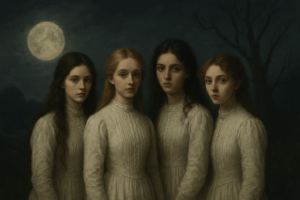
🖋️ Joan Lindsay, narrator of the suspended dimension
There are writers who try to describe reality and others who try to cross it. Joan Lindsay belonged to the latter. In her house at Mulberry Hill, surrounded by clocks that defied time, she imagined a story that still hovers between dream and report, myth and investigation.
When asked if Picnic at Hanging Rock was based on a true story, she smiled and said, “Every story is true, if you tell it at the right moment.”
Perhaps that was her secret: to catch the instant when reality cracks open — and turn it into art.
🕸️ The Crime That Isn’t There
Picnic at Hanging Rock doesn’t recount a crime — it exposes our need for one. It reveals how desperately we crave a culprit, a diagnosis, a motive. And how, instead, life — like the mind, like the body — always remains partly inaccessible.
Lindsay’s novel is a gentle trap: it promises resolution and gives us an abyss. Yet it’s within that abyss that awareness begins.
Lindsay once wrote: “Not knowing, is a kind of freedom that few can bear”
Perhaps that is the real mystery — not the girls’ disappearance, but our inability to accept that some vanishings — in time, in memory, in the mind — do not need to be explained.
Samanta Sforna – All rights reserved.