

How a sweet opium syrup became a symbol of lost childhood in Victorian Britain
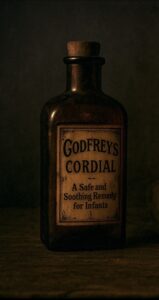
England, 1845 – In North Marston, a small village in Buckinghamshire, night has already fallen. The air is damp and heavy with coal smoke. In a house of blackened brick, a young mother holds her eleven-week-old baby in her arms. The child has been crying for hours — perhaps fever, perhaps colic. She is exhausted. Tomorrow she must rise before dawn to return to work in the fields; her husband is away, employed on a railway site. On the table, beside a flickering candle, stands a small amber-glass bottle. The label, printed in Gothic type, promises relief:
“Godfrey’s Cordial – A safe and soothing remedy for infants.”
One teaspoon, then another. The baby stops crying. When the mother wakes at sunrise, Thomas no longer breathes — the cordial has done its work.
What Was a “Cordial”
In medical and popular language between the seventeenth and nineteenth centuries, a cordial was a liquid preparation — usually a syrup or elixir — meant to “cheer the heart” (from the Latin cor, cordis) and “invigorate” the body.
Originally intended as a tonic or restorative, over time the term became synonymous with a calming or digestive remedy, often based on alcohol, sugar, aromatic herbs and opiates such as laudanum.
Laudanum: The Liquid Opium of the Victorian Age
Opium did not come from laboratories but from the fields. It was extracted from the opium poppy (Papaver somniferum), a delicate flower with pale petals and seed pods filled with a thick white sap. When the pods were carefully scored, that milky latex seeped out and, once dried, turned into a dark, bitter resin — raw opium.
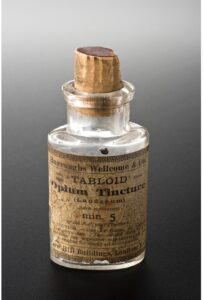
From this substance, rich in natural alkaloids such as morphine, codeine, and papaverine, apothecaries prepared tinctures and syrups. One of these tinctures was laudanum – the “liquid opium” of the Victorian age. It was made by dissolving opium in ethyl alcohol to extract all its active compounds.
Invented in the sixteenth century by the physician and alchemist Paracelsus, and later refined in the seventeenth by Dr.Thomas Sydenham, laudanum became one of the most widespread remedies in modern Europe. It was sold as a panacea: for pain, coughs, insomnia, colic, and melancholy. It was legal, inexpensive, and available in every apothecary. But its apparent sweetness concealed an invisible danger.
Laudanum was highly addictive and toxic even in small doses. For many men and women of the Victorian era, it was a daily comfort; for children, it was often a death sentence. Godfrey’s Cordial contained this very substance: it was laudanum that ensured “domestic peace” — and, too often, silenced it forever.
“A Help” for Weary Mothers
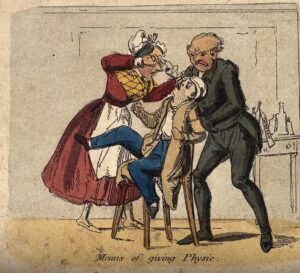
The story of little Thomas Walker was neither unique nor exceptional. Throughout the nineteenth century, hundreds — perhaps thousands — of English infants died the same way: lulled forever by a legal medicine, sold without prescription and regarded as “a help for tired mothers.”
Godfrey’s Cordial, created in the eighteenth century by an apothecary named Thomas Godfrey, was among the most popular remedies in Victorian Britain. It appeared as a thick, dark, sweet syrup. Recipes varied slightly from maker to maker, but the base was always the same: molasses, alcohol, water, sassafras oil and above all laudanum — an opium tincture rich in morphine.
It was marketed as a “safe and soothing remedy for infants,” but in reality it acted as a narcotic: one teaspoon could quiet a restless baby; two could make it sleep for hours. Too many — and it was the end.
The Opium of Victorian Childhood
In industrial-era England, a crying baby was a luxury few could afford. Working-class mothers labored in factories, mills, or as domestic servants; there were no leaves, no nurseries. Often, infants were left with improvised nurses — elderly women who cared for several babies at once. In such conditions, a remedy that “made the little ones sleep” was seen as a blessing. One drop of cordial and the room filled with silence.
But the price of that silence was terrible. The effects of opium on infants were devastating:
slowed heartbeat, respiratory distress, loss of appetite. The babies stopped crying — but also stopped feeding. Many died slowly of starvation or overdose, while no one understood the cause.
In 1845, when Thomas Walker died, no law restricted the sale of opium-based products. Pharmacists displayed them beside sweets. An ounce of Godfrey’s Cordial cost a penny — less than a cup of tea.
The Day of the Inquest
Thomas Walker’s death was recorded as “natural causes.” During the inquest, his mother explained she had given him two teaspoons of cordial and a poppy tea “to make him rest.” No one blamed her.
The coroner simply noted that “the mother acted in good faith, according to common custom.”
At the time, English courts were full of similar cases — children dead after taking syrups, powders, or elixirs containing morphine, laudanum, chloroform, or ether. Yet justice saw no culprits, only misfortunes.
The true culprit, if one may call it that, was a non-existent health system, where the boundary between medicine and poison depended on the seller’s experience. A doctor in Nottingham wrote in 1849:
“It is impossible to calculate how many infants die every year from the abuse of laudanum, administered not from malice but from ignorance.”
When Remedy Becomes Addiction
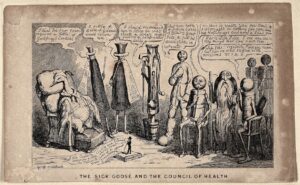
The success of Godfrey’s Cordial did not depend solely on its calming effect on children. In many families, adults used it too. Some mothers, exhausted or depressed, drank small doses “to revive themselves.” Opium, after all, was a common ingredient in dozens of preparations — cough drops, digestive tonics, remedies for melancholy.
In 1850, The Lancet described England as “a nation of opium sleepwalkers.” The consumption of opiate derivatives — in the form of laudanum, cordials, pills, or mixtures — was estimated at more than 200,000 doses daily. Only a few physicians began to suspect that this “domestic peace” carried an unacceptable price.
The Face of Science at the Time
To understand how such a tragedy was possible, we must recall that Victorian medicine was still a science in formation. Toxicology had just been born: in 1814, the French physician Mathieu Orfila had published the first scientific treatise on poisons, but his discoveries were little known outside academic circles.
In England there were no standard dosages or mandatory labels. The opium concentration in cordials could vary from bottle to bottle.
Sellers of medicines were often grocers or apothecaries, not trained pharmacists. A parliamentary inquiry in 1857 revealed that many infants died from excessive doses of laudanum, given “by mistake or from habit.” Yet regulation would take decades to arrive.
A Remedy More Common Than Milk
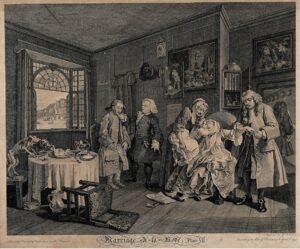
In 1840, London’s infant mortality exceeded 30%. One child in three did not reach the age of five. The causes were many — malnutrition, infections, lack of hygiene. In this context, the death of a baby raised little scandal. The use of Godfrey’s Cordial was especially common among the poor. Wealthier families could afford a doctor; the lower classes relied on over-the-counter cures. The cordial was seen as practical and cheap. A local newspaper observed in 1843:
“Among working mothers, the cordial is more common than milk itself.”
It was a poison that thrived in collective indifference, for it rendered invisible a problem: difficult babies, sleepless nights, the fatigue of mothers. A spoonful of syrup could erase it all — even guilt.
The Slow Awakening of Public Conscience
From the 1850s onward, some doctors began to openly denounce the abuse of cordials. Articles in The Lancet, pamphlets and parliamentary debates raised the alarm. In 1868, the Pharmacy Act established that only registered pharmacists could sell opium and its derivatives. Yet many “patent medicines” — like Godfrey’s Cordial — remained legally available.
Only in 1908, with the Poisons and Pharmacy Act, was the free sale of such preparations finally banned. But the law came too late: the cordial had already been given to children for over a century.
Thomas Walker: Just a Name in a Register
If little Thomas’s story occurred today, it would be treated as a case of pharmaceutical poisoning. There would be an investigation, a toxicology report, perhaps a trial. In 1845, however, his name was merely a line in a ledger.
And yet his case embodies all the paradoxes of the Victorian age: a time that celebrated scientific progress while allowing its most fragile children to die from a shop-bought medicine. Thomas’s mother was no criminal; she was a victim of a culture that confused silence with health and calm with care.
The Science of Sleep
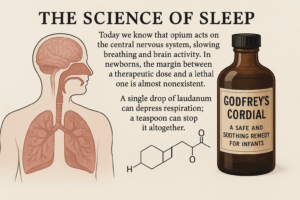
Today we know that opium acts on the central nervous system, slowing breathing and brain activity. In newborns, the margin between a therapeutic dose and a lethal one is almost nonexistent. A single drop of laudanum can depress respiration; a teaspoon can stop it altogether.
In the nineteenth century, however, knowledge of respiratory mechanisms was rudimentary. Autopsies rarely detected traces of opium and physicians mistook poisoning deaths for “congenital weakness” or “nighttime chill.”
Modern medicine was born, in part, from such errors. Every child who died from Godfrey’s Cordial contributed, unknowingly, to the rise of toxicology and pharmacovigilance.
A Crime Without an Assassin
To call this story a “true crime” might seem forced: there are no culprits in the traditional sense. Yet it is one, in the deepest meaning of the term. The crime was not the act of a single person, but of an entire society — the absence of responsibility, the collective blindness of an era that saw suffering as fate rather than injustice.
Behind Thomas Walker’s death lay many causes: the economic interests of medicine manufacturers, the silent complicity of sellers, and the indifference of authorities who ignored warnings for decades. The true killer, if one can use the word, was necessity — hunger, exhaustion, the loneliness of Victorian mothers.
From History to Memory: The Last Taste of Life
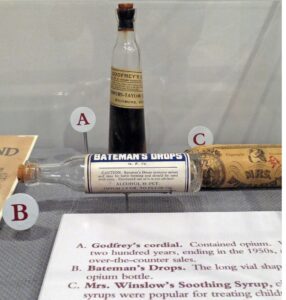
Today, in British medical history museums, a few bottles of Godfrey’s Cordial are still on display. The label is elegant, almost innocent. No skulls, no warnings — only the promise of “soothing relief.”
Looking at them provokes both fascination and horror. It is hard to imagine that this sweet liquid, sold as an act of care, was for so many infants the last taste of life.
But remembering Thomas Walker reminds us of a truth still valid today: no medicine is neutral or harmless. Every remedy carries responsibility and every age has its own “cordials” — substances accepted, sold, abused, until the day we discover they were poison.
Death by Indifference
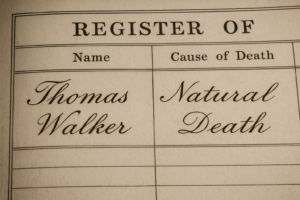
In the 1845 Buckinghamshire death register, beside the name Thomas Walker, a single faded word is written: natural death. There was nothing natural about his death. It was the outcome of a chain of habits, ignorance and necessity that ran through Victorian society. A century and a half later, his story still speaks to us.
It reminds us that evil does not always wear the face of a criminal, and that history’s worst crimes are often committed not out of hatred, but indifference. Thomas Walker was not murdered by a person — he was killed by an era.
And his interrupted breath remains a warning, as sweet and terrible as the taste of Godfrey’s Cordial.
🧪 The Science Corner
💀 Box 1 — Opium: The Flower of Pain

💧 Opium is a natural substance extracted from the poppy (Papaver somniferum).
It contains a mix of alkaloids that act directly on the central nervous system, including:
• Morphine → powerful painkiller and sedative
• Codeine → milder narcotic
• Papaverine → antispasmodic
• Noscapine → cough suppressant
🧬 These compounds bind to the brain’s opioid receptors, blocking pain and slowing vital functions such as breathing and heartbeat.
The result is an artificial calm — relief that teeters on the edge of silence.
☠️ In the nineteenth century, opium was legal, cheap, and found in countless household remedies.
Its dangers were known only when the silence became permanent.
⚗️ Box 2 — Inside the Bottle: The Science of Laudanum
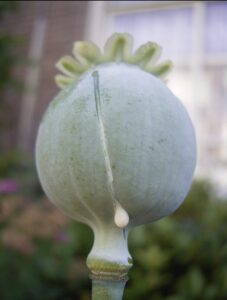
💧 Laudanum is an alcoholic tincture of opium, meaning that opium was dissolved in ethyl alcohol to create a liquid medicine.
Once swallowed, it enters the bloodstream and reaches the brain within minutes.
🧬 Like opium, it contains morphine, codeine, papaverine, and noscapine — alkaloids that suppress pain but also slow the body’s vital rhythms.
The effect feels warm and soothing… until the dose becomes too high.
⚠️ Breathing slows, the heartbeat weakens, and consciousness fades.
👶 For infants, the risk was catastrophic: their undeveloped bodies could not metabolize morphine, and even a few drops could halt breathing within seconds.
☠️ What Victorian Britain called a “soothing cordial” was, in truth, a lethal sedative wrapped in sweetness — a remedy that could quiet a child’s cries and their life at the same time.
Samanta Sforna – All rights reserved.