

Bradford, autumn 1858 – Amid the everyday bustle of a crowded market, an invisible danger lurked, ready to turn an innocent gesture into tragedy: a single bite of a mint candy could be deadly. The arsenic hidden in those refreshing sweets turned the city into a nightmare and set in motion laws that would forever change the safety of food and medicine in the United Kingdom.
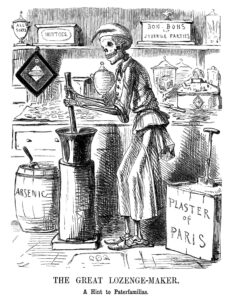
Bradford: Smoke, Markets and Daily Life
Located in northern England, in the county of West Yorkshire, Bradford was a rapidly growing industrial city in the 1850s. Textile factories dominated the skyline, their smokestacks blending gray columns of smoke with the autumn fog. The streets were alive: weary workers returning from the mills, street vendors selling fruit, vegetables and sweets, and groups of children running among carts and stalls with sugar-sticky hands.
The weekly market was the heart of the city. The smell of freshly baked bread mingled with the spiced aroma of candies and sweets. But beneath this vibrancy lay poor sanitary conditions: overflowing, foul-smelling sewers, stagnant water, and the constant threat of diseases such as cholera. Despite the industrial boom, the population was vulnerable to food contamination and fatal mistakes.
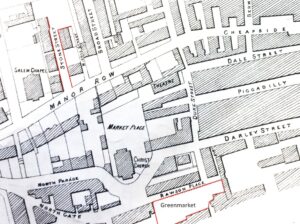
A Sweet Routine
Among the most popular vendors at the market was William Hardaker, nicknamed “Humbug Billy” for his intensely flavored, slightly spicy candies. His stall at Greenmarket was a place of joy every Saturday for children and adults alike, who flocked to taste his sweet creations.
Behind the scenes, in Joseph Neal’s workshop, mint candies were carefully crafted. Sugar, gum, and peppermint oil were mixed by hand, the dough rolled out on wooden boards and cut into small candies ready for packaging.
However, to save costs, Neal had developed the habit of substituting some sugar with daft, a cheap powdered chalk. A seemingly harmless choice in daily routine, but combined with a small mistake, it was destined to become a deadly disaster that would forever change the face of the city.

The Fatal Mistake: Chalk or Arsenic?
Neal ran out of chalk and sent his tenant, James Archer, to Shipley, about five miles away, to get more. The local grocer, Charles Hodgson, was ill, so young William Goddard, eager to secure an apprenticeship, served Archer.
Unknowingly, Goddard took a barrel identical to the chalk one, but containing arsenic trioxide, a deadly poison then used in medicines, candles, dyes and wallpaper. The barrel was labeled only at the bottom, and Goddard did not notice.
When Neal and the expert James Appleton began mixing the dough, they immediately noticed differences: it was more fluid, darker, and had a stronger smell. Appleton violently vomited, and Neal also felt ill, but no one suspected arsenic.

Selling Candies to an Unaware Community
Bradford’s market was in full swing. That morning, sunlight illuminated stalls full of fruit, vegetables, and sweets, and the air was thick with sugary aromas. Hardaker displayed the mint candies as usual, unaware of the hidden danger.
Children soon found their hands sticky with sugar, popping candies into their mouths, while men and women sampled the treats, sipping tea and chatting, oblivious to the poison they were tasting. Within hours, hundreds had consumed the intoxicating sweets.
But Sunday morning brought the first shadow of tragedy: Elijah Wright and two boys, John Scott’s sons, were found dead. Initially, the cause was attributed to cholera, a disease sadly common in the city. But as more deaths followed, a disturbing pattern emerged: something invisible and lethal was silently striking Bradford, turning daily life into a nightmare.

Police Intervention, but Too Late
Officer Campbell was among the first to notice a link between the sudden deaths and the candies sold at the market. Quickly, he seized the remaining stock from Hardaker and Neal, finding contaminated fragments that confirmed his suspicions.
Detective William Burniston escorted Neal to Shipley, where grocer Hodgson confirmed the horror: the barrel mistaken for chalk contained arsenic trioxide, a deadly poison. Apprentice Goddard was arrested immediately.
The city, paralyzed by panic, closed in on itself. Notices were posted on every door, and town criers walked the streets to warn residents. Meanwhile, Dr. John Henry Bell began recognizing symptoms of arsenic poisoning and treating patients—sixty in total, many already severely ill. Bradford hung between fear and grief as the scale of the tragedy became clear.
The Tragedy Spreads
By Monday, twelve were dead and dozens more gravely ill. The police intensified searches at Neal’s workshop, discovering hundreds of small candy fragments—broken pieces or leftover mint dough—all contaminated with arsenic.
Neal’s wife admitted to having found other suspicious pieces and burning them, unaware that these remnants could have helped experts identify the poison and save lives. Every seemingly insignificant scrap carried the same deadly substance as the candies sold at the market.
Fear hung over the city. Markets that were once lively and noisy were now nearly deserted; children no longer ran among the stalls, and families stayed indoors, paralyzed by anxiety. Bradford seemed suffocated by an invisible poison that had torn apart the very fabric of the community.
Medicine and Toxicology of the Time
By the mid-19th century, toxicology was still in its infancy. Arsenic was known as a potent poison, but distinguishing its effects from common illnesses like cholera was nearly impossible. Families watched their children and neighbors writhe in vomiting, diarrhea, and agonizing pain, unable to understand the cause, and doctors were equally puzzled.
Dr. John Henry Bell observed with growing concern the flood of patients at his practice, many already critically ill. Suspecting poisoning, he carefully collected some suspicious mint candies and entrusted them to expert chemist Felix Rimmington for analysis.
In 1858, the typical procedure was:
1. Collection of samples – Bell took candies directly from the suspicious batches.
2. Submission to a chemist or pharmacist – Samples were given to a chemical analyst, in this case Rimmington, who had the tools and expertise to identify poisonous substances.
3. Chemical analysis – The chemist applied contemporary chemical tests, such as the Marsh test, which converted invisible arsenic into a visible deposit, allowing for reliable detection.
4. Reporting results – The chemist confirmed the presence of poison, linking the deaths to the contaminated sweets and triggering the official investigation.
Thus, “having them analyzed” did not mean Bell could test them himself; he relied on an expert chemist to identify the toxic substance.
Using these methods, Rimmington uncovered the terrible truth: each candy contained lethal doses of arsenic trioxide. The chemist’s confirmation was decisive, linking the patients’ symptoms to the contaminated sweets, shocking the city, and revealing the full scale of the disaster.
The case exposed how fragile food safety was at the time. Even ordinary actions, like making candies, could become deadly without proper scientific knowledge and regulations. The work of Bell and Rimmington marked a crucial step toward controlling and preventing accidental poisonings, paving the way for stricter laws that would protect public health in the years to come.
The Illusion of Justice
On December 9, 1858, Bradford’s courtroom was packed. Grieving families, neighbors, and curious onlookers gathered to witness the trial that was meant to bring justice for twenty victims and hundreds of the sick.Judge Baron Warren presided solemnly, while Joseph Neal, the candy maker, William Goddard, the apprentice who had accidentally delivered the arsenic and Charles Hodgson, the grocer, sat in the dock.
Despite the gravity of the tragedy, all were acquitted. The law at the time could not handle negligence without intent: the disaster had resulted from human error and unfortunate circumstances, not criminal intent.
Outside the courthouse, the city was in shock. Streets buzzed with murmurs of outrage. Newspapers openly condemned what many considered a failure of justice: a terrible, avoidable tragedy that exposed the weaknesses of the legal system and the fragility of food safety at the time. Families had to face the reality that no one was being held accountable for the loss of their loved ones, while Bradford slowly began reflecting on the need for stricter laws to protect its citizens.
Laws and Reforms
The Bradford tragedy sparked nationwide outrage and pushed Parliament to introduce new protections for citizens. In 1860, the Adulteration of Food or Drink Act was passed, the first law aimed at punishing those who sold adulterated foods as pure. The law stipulated that anyone adding harmful or cheap substances to food or drink risked criminal penalties, laying the foundation for consumer protection and food safety.
A decade later, the Bradford case also influenced the Pharmacy Act of 1868, which introduced stricter rules for the sale and distribution of chemicals and medicines. The law required pharmacists and grocers to register hazardous substances, sell only to authorized individuals and ensure proper labeling.
These reforms marked a fundamental change: for the first time, food and pharmaceutical safety became a concrete legal responsibility, not just a moral or professional duty. The Bradford tragedy, though painful, became a decisive catalyst for preventing similar disasters and protecting public health.
Prevention: The Only Way to Avoid Mistakes
In the autumn of 1858, Bradford seemed absorbed in its usual vibrancy: children ran among the stalls, women chatted over the smells of fresh bread and sweets, weary workers returned from the mills. But beneath these familiar gestures lurked an invisible danger: a single bite of a mint candy could turn a moment of innocent pleasure into tragedy. While the city went about its routines unaware, Neal, Goddard, and Hodgson focused on their daily tasks, oblivious to the small error that was already changing many lives forever.
In just a few hours, normalcy was shattered: laughter turned to silence, beds remained empty, homes were filled with grief. Each contaminated candy became a tangible warning: even unintentional negligence can have irreversible consequences. From the sorrow and memory of the victims arose laws and regulations, like the Adulteration of Food or Drink Act of 1860 and the Pharmacy Act of 1868, tools that still protect public health today and make food and pharmaceutical safety
BOX: What’s…?👇
🍬🟢 Daft 🪨
•Type: Cheap chalk-like powder
•Purpose: Replaced part of the sugar in mint sweets 🍭 to reduce costs 💸
•Risk: Harmless alone, but accidentally swapped with arsenic trioxide → deadly 🪦
☠️🔴 Arsenic Trioxide (As₂O₃)
•Type: Potent poison (arsenic + oxygen)
•Found in: Medicines, 💊 dyes, candles, wallpaper
•Effects: Vomiting 🤮, diarrhea, severe abdominal pain 🤕, death ☠️
•Bradford tragedy: Accidentally mixed into mint sweets → dozens of deaths ⚰️, hundreds poisoned 🏥
💡 Key Takeaway:
Even ordinary substances can become fatal if confused or mishandled.
Vigilance, knowledge and regulation save lives. 🛡️

Trick or Poison?
🎃💀
Samanta Sforna – All rights reserved.