

When Italian and American history intertwine in an endless mystery.
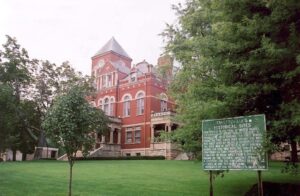
A Christmas Eve That Changed Everything
It was Christmas Eve in 1945 when a terrible fire destroyed the Sodder family home in Fayetteville, West Virginia. George and Jennie Sodder lived there with nine of their ten children (the eldest was serving in the army). That night, only four of their children and the parents managed to escape the flames. The other five — Maurice, Martha, Louis, Jennie and Betty — disappeared without a trace.
Although authorities declared that the children had died in the fire, their bodies were never found. From that moment, the Sodders embarked on a lifelong search, filled with clues, suspicions and mysteries that were never resolved.
The Origins of the Sodder Family
George Sodder, born Giorgio Soddu (according to some sources) in 1895 in Tula, Sardinia, emigrated to the United States at just thirteen. After years of working as a laborer and driver, he settled in Fayetteville, where he founded a small transportation business. In 1922, he married Jennie Cipriani, also of Italian descent, and together they built a two-story wooden house just outside town. The couple had ten children and soon became one of the most respected families in the area.
But George was a man of strong opinions. His firm opposition to the Italian fascist regime earned him several enemies in the local Italian-American community. Only a few months before the fire, an insurance agent — after George had refused his proposal — threatened him with ominous words:
“Your house will be set on fire and your children will be destroyed for what you said against the fascist regime and those who lead it.”
A few days before the tragedy, according to George, another man stopped in front of their house warning that the electrical system “could cause a fire” — a strange statement, as the system had recently been upgraded and certified safe.
The Christmas Eve Fire
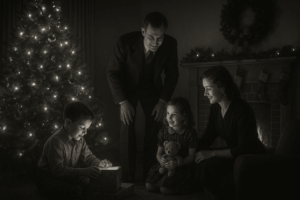
On the evening of December 24, 1945, the family celebrated peacefully. The younger children were allowed to stay up to play with their newly received gifts. Around 12:30 a.m., the phone rang: a woman asked for an unknown person, with laughter and clinking glasses in the background. Jennie hung up without paying much attention. Shortly after, she heard a thud on the roof, followed by a rolling noise.
By 12:45 a.m., the smell of smoke woke her again. George’s office, where the phone and fuse box were located, was on fire. Within minutes, the house became an inferno. George, Jennie, and four of their children managed to escape, but the five remaining in the attic never responded to their cries.
Desperate Attempts and Delayed Rescue
George tried in every way to reach the attic: he attempted to use a ladder, which mysteriously had disappeared and tried to move his trucks under the windows, but both refused to start. The phone wasn’t working and nearby lines were all out of service. The firefighters arrived only at dawn, when the house had already been reduced to ashes.
The fire chief, F.J. Morris, told the Sodders that no bodies had been found. According to the official version, the flames had consumed everything, but independent experts later deemed this explanation unlikely.

The First Doubts
The family never believed the short-circuit theory. The Christmas lights, in fact, had remained on during the early stages of the fire. In the following days, George found the missing ladder thrown into a ditch, while a telephone technician discovered that the line had not burned but had been deliberately cut.
Rumors spread that a man had confessed to cutting the cable “by mistake” but his identity was never confirmed. The entire event seemed increasingly mysterious.
Inexplicable Evidence
Jennie, unable to accept the absence of remains, conducted experiments on her own. She burned animal bones in the yard to test if they could completely disintegrate — but they never did. A crematorium technician confirmed that even at 1,000°C human bones do not fully dissolve. The Sodder house fire could never have reached such temperatures.
In the spring, the family covered the rubble and planted flowers, turning the site into a commemorative garden. Yet new clues continued to emerge: a bus driver claimed to have seen “balls of fire” thrown at the house and months later, little Sylvia found an object in the garden resembling an incendiary device.
Early Theories and Sightings
Several people reported seeing the children after the fire:
• A woman claimed to have noticed them in a car leaving the burning house
• Another said she had served them breakfast in a restaurant, accompanied by adults
The testimonies were never officially verified but reinforced the Sodders’ belief that the children had been kidnapped.
Private Investigations and New Mysteries
George and Jennie hired a private investigator, C.C. Tinsley, who discovered a disturbing detail: among the jurors of the coroner who declared the fire “accidental” was the man who had threatened George months earlier. Rumors circulated that the fire chief had found a “human heart” among the ashes and secretly buried it.
When George and Tinsley went to check, they indeed found a box containing a fleshy mass, which turned out to be raw beef liver — probably placed there to stop them from digging further.
New Searches and the Famous Billboard
In 1949, an expert from Washington D.C. reexamined the site and found bone fragments belonging to a 16–22-year-old, an age incompatible with the missing children. The bones showed no signs of fire: according to the Smithsonian Institution report, they had ended up in the soil by chance, possibly mixed with earth from a cemetery.
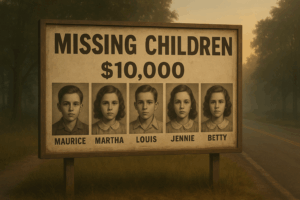
Despite federal investigations being closed, the Sodders continued seeking answers. In 1952, George had a massive billboard installed on Route 16 with photos of the five children and a $10,000 reward. The sign remained for decades, becoming a local and national symbol of the mystery.
The Letter and the Photograph of “Louis”
In 1967, more than twenty years after the fire, Jennie received an envelope with no return address from “Central City, Kentucky.” Inside was a photo of a young man and a note:
“Louis Sodder. I love you, brother Frankie. Ilil boys A90132.”
The young man in the photo bore a striking resemblance to Louis Sodder, then a nine-year-old child. George had the photo enlarged and added it to the billboard, publicly asking for help in identifying him. According to the family, a private investigator went to Kentucky but never returned — however, this episode was never officially verified.

The Later Years and the Legacy of the Mystery
George died in 1969 without finding the truth and Jennie lived until 1989, tending the commemorative garden and wearing black for the rest of her life. The youngest daughter, Sylvia, continued to tell the story of her missing siblings, keeping the family memory alive.
The large Sodder billboard remained until the late 1980s, becoming a symbol of perseverance and the grief of a family that never gave up.
A Mystery That Endures
Nearly eighty years later, the case of the Sodder children remains one of the most famous unsolved mysteries in the United States. Theories remain open:
1. Accidental fire – the official version, but physically unlikely
2. Organized kidnapping – possibly connected to George’s anti-fascist stance
3. Cover-up or investigative negligence – a minority theory, but discussed in some inquiries
No concrete evidence has ever confirmed what truly happened that night. Today, the story of the Sodders is remembered as one of the most heartrending family tragedies of the twentieth century: a drama suspended between loss, mystery and the eternal hope of finding one’s children.
Nursing Care in the Context of the Sodder Children Case
The Sodder children case, although occurring in an out-of-hospital setting, offers an important opportunity to reflect on the role of nurses in supporting families affected by complex trauma. Nurses, whether in professional settings or external support roles, play a crucial role in identifying, managing and supporting families exposed to traumatic events.

Assessment of Family Well-being: Advanced nursing practice involves systematic tools to identify signs of psychological distress, including anxiety, insomnia, post-traumatic symptoms, and alterations in family dynamics. This assessment allows for the planning of targeted and timely interventions, preventing the escalation of emotional distress (Naef et al., 2025).
Targeted Psychological Support Interventions: Nurses employ brief counseling strategies, active listening and mediation among family members, facilitating emotional expression and the processing of the traumatic event. These interventions have proven effective in reducing psychological distress and improving family communication (Checa-Checa et al., 2025).
Family Education and Empowerment: An integral part of the nursing role is promoting family resilience and self-efficacy. Nurses provide information on common emotional reactions to trauma, strategies for coping with uncertainty and guidance on when to seek specialist psychological support (Lindlöf et al., 2024).
Caregiver Protection and Burnout Prevention: In situations of prolonged stress, it is essential to support caregivers as well, providing professional supervision, coping strategies and specific training to preserve emotional well-being and prevent secondary stress in healthcare providers. (Checa-Checa et al., 2025).
In contexts like the Sodder case, nursing care demonstrates how technical competence and humanity are closely interconnected. Nurses not only provide practical support but also act as mediators, educators and emotional facilitators, contributing to stabilizing family dynamics and promoting a path of adaptation and resilience, even in the face of extreme traumatic events.
📚 References
• Checa-Checa, A., Medina-Maldonado, V., Ramírez, A., & Rodríguez Diez, J. (2025). Family support strategies during intensive care unit: A systematic review. BMC Nursing, 23(1), 1–12. https://doi.org/10.1186/s12912-025-02814-6
• Lindlöf, J., Turunen, H., Coco, K., Huhtakangas, J., Verhaeghe, S., & Välimäki, T. (2024). Empowering support for family members of patients with traumatic brain injury during acute care: Insights from family members and nurses. Journal of Advanced Nursing, 80(11), 7674–7689. https://doi.org/10.1111/jan.16424
• Naef, R., et al. (2025). Nurse-led family support intervention for families of critically ill patients in intensive care units: A cluster-randomized trial. JAMA Internal Medicine, 185(2), 1–10. https://doi.org/10.1001/jamainternmed.2025.1234
Samanta Sforna – All rights reserved.