

Let’s analyze Hitchcock’s masterpiece that explores the primal fear and fragility of human certainties in the face of the unpredictable.
In 1963, Alfred Hitchcock created one of his most unsettling and innovative works: The Birds. More than sixty years after its release, the film retains an eerie allure and significant relevance for contemporary audiences. It is not simply a period thriller, but a profound meditation on the unpredictability of violence, the precariousness of everyday life, and fear as a collective and universal experience.
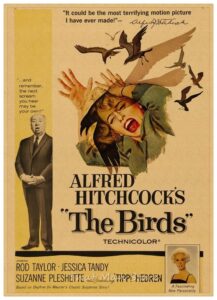
Inspired by Daphne du Maurier’s story of the same name, The Birds forgoes the traditional identifiable “monster” to be defeated, replacing it with an enigmatic and indecipherable enemy: common birds. Seagulls, crows, and sparrows — familiar, ordinary elements of the landscape — transform into bearers of chaos and collective terror, without any apparent motive. This very lack of explanation forms the beating heart of the work: an attack devoid of logic, generating a deep anguish rooted in loss of meaning and control.
A Threat Without Reason
In Bodega Bay, a quiet seaside town in California, daily balance is suddenly disrupted by unusual aggression from the avian world. The first signs are isolated: a seagull violently strikes a woman in a boat; shortly after, a flock of sparrows invades a private home through the chimney. The situation escalates rapidly. Crows gather unusually on power lines outside an elementary school and suddenly attack children and teachers, sowing panic. Sea gulls begin attacking passersby, smashing windows, invading homes, and severely injuring residents, striking eyes and hands with alarming precision, in a crescendo of brutality.
What is disturbing is not only the violence itself but the absence of motive. There is no scientific, environmental, or supernatural explanation justifying the birds’ behavior. No authority offers answers. Nature, apparently, acts blindly and chaotically.
In this context, Hitchcock consciously overturns thriller genre conventions: there are no clues to decipher, no antagonists to unmask. The threat stands as an undeniable fact, an event without logic or intent. For this reason, the attacks acquire profound symbolic significance: they evoke collective crises — wars, natural disasters, pandemics — that suddenly erupt into reality without warning, undermining every certainty.
Trauma in Real Time: Psychological Reactions to Threat
One of the most significant aspects of The Birds is its nuanced and credible portrayal of characters’ psychological responses to a sudden, inexplicable catastrophe. The narrative shows how each individual copes differently with shock, displaying a wide range of reactions: from denial to panic, emotional confusion to psychophysical collapse.
Melanie Daniels, played by Tippi Hedren, initially appears as a confident, ironic, and independent young woman of high society. Her arrival in Bodega Bay coincides with the start of the inexplicable events, and her journey throughout the film is marked by progressive emotional breakdown. As the attacks intensify, Melanie loses control, experiences hypervigilance, and ultimately suffers a true psychic collapse. Her condition approaches an acute trauma reaction: impaired lucidity, emotional disconnection, behavioral regression.
Another emblematic example is Lydia Brenner, mother of protagonist Mitch (Rod Taylor), played by Jessica Tandy. After discovering the mutilated body of a farmer, a victim of a bird attack, Lydia immediately reacts with emotional shutdown. Her face stiffens, her speech ceases, and her behavior evolves into paralyzing anxiety, with symptoms suggesting acute post-traumatic stress disorder: social withdrawal, hypersensitivity, and a marked need for control within the family unit.
Hitchcock’s direction deliberately avoids simplifications or didacticism, choosing instead to observe — often with dry cuts and static close-ups — the evolution of psychological distress. The result is a story where collective catastrophe reflects individual fragilities, transforming each character into a clinical case and every scene into testimony of the tension between rationality and survival.
The Hostile Everyday
One of The Birds’ most disturbing choices is to assign the threat not to exotic or monstrous creatures, but to common bird species: seagulls, crows, sparrows. Animals perfectly integrated into urban and rural environments, usually perceived as harmless or even familiar. This apparent normality, exploited with extreme awareness by Hitchcock, becomes the main tool to generate unease. The disturbing element is not so much the violence itself, but that it is exercised by well-known presences, integral parts of the visual and auditory landscape of human life.
The progressive transformation of the setting into a narrative trap — windows that no longer protect, roofs violated from above, power lines turned into observation and siege points — suggests a structural loss of control. The chirping, usually associated with calm, becomes a sign of imminent danger; a domestic space, like a living room or kitchen, turns into a vulnerable place.
Hitchcock stages a specific form of anguish: that generated by the betrayal of the ordinary. The familiar environment revolts against its inhabitants, destabilizing the perceptual relationship between safety and space. This dynamic finds parallels in trauma psychology, where critical experiences can turn familiar contexts into anxiety-provoking scenarios. In this sense, The Birdsdoes not simply narrate an external attack but constructs a narrative about the gradual erosion of trust in reality.
No Explanation, No Music
The Birds stands out in cinema history for two radical choices, both narrative and stylistic: the elimination of a rational explanation for events and the complete absence of a conventional soundtrack. Hitchcock deliberately refuses to provide motives for the avian threat: no scientific, ecological, or supernatural hypothesis is proposed. Violence erupts, birds attack, and everything happens without apparent cause; even in the ending, instead of offering resolution, the film leaves the viewer suspended in unchanged tension. The birds stop but remain present; the alarm eases but does not cease. The traditional sense of closure expected in the genre is completely denied.
At the same time, Hitchcock adopts an equally bold choice: the total absence of diegetic or non-diegetic music. The orchestral score, a classic suspense-building element, is replaced here by a soundscape composed exclusively of effects produced by the Trautonium, a pioneering electronic instrument. Ambient noises — wing beats, claw screeches, glass shattering — become the sole sonic accompaniment, contributing to a hyperrealistic and disturbing perception of events.
The result is an immersive and disorienting experience that amplifies the sense of authenticity. The absence of musical commentary prevents any emotional guidance, forcing the viewer to confront directly the unease generated by the images. Fear is neither suggested nor heightened: it is left to exist in its rawest, most immediate form, like a real-time report. In this sense, The Birds anticipates forms of auditory realism that would become central in postmodern cinema.
Beneath the Surface: Psychological Conflicts and Family Dynamics
The Birds develops a complex psychological subtext fueled by interpersonal tensions among characters, especially among the central female figures. Melanie Daniels (Tippi Hedren), Lydia Brenner (Jessica Tandy), and Annie Hayworth (Suzanne Pleshette) embody three distinct forms of femininity and affective relationships with Mitch (Rod Taylor), the male protagonist: the first is the emancipated, autonomous, unconventional woman; the second, the protective widow mother suspicious of strangers; the third, Mitch’s melancholic and resigned ex-partner, still tied to an unresolved bond.
The dynamics among these women are never explicitly conflictual but full of underlying tension, marked by glances, silences, subtle gestures of exclusion or defense. Hitchcock thus constructs a network of emotional rivalries and affective competitions that intertwine with the eruption of catastrophe. The film operates on two levels: the external threat and the internal psychological and relational disorder.
Some critical readings, including that of scholar Camille Paglia, interpret the bird attacks as symbolic projections of repressed urges. In this interpretation, birds become metaphors for unexpressed sexual desire, maternal jealousy, fear of abandonment or loss of control. Nature’s violence thus acquires allegorical value, expressing unresolved tensions among characters and latent conflicts within their unconscious.
From this perspective, The Birds also emerges as a psychological drama, where the intrusion of natural anomaly does not erase but amplifies internal emotional and familial disharmony. Hitchcock, as in earlier works, masterfully intertwines thriller elements and analysis of interpersonal bonds, crafting a layered narrative resistant to a single interpretation.
Historical Context and Social Tension
Released in 1963 during the Cold War, The Birds fits into a cultural climate marked by acute awareness of collective vulnerability. The shadow of a sudden threat — nuclear or otherwise — loomed over Western daily life, fueling widespread insecurity and instability. Although the film contains no explicit geopolitical references, its narrative construction effectively reflects the psychological state of the era: a reality where order can be overturned at any moment without warning or explanation. The lack of clear origin for the bird attacks becomes a metaphor for the unpredictability of modern disaster.
Alongside this historical reading, the film also anticipates an ecological awareness that would become more explicit in subsequent decades. The birds’ rebellion can be interpreted as a symbolic response to humanity’s violation of natural balances, alteration of environmental rhythms, and invasion of inappropriate spaces. Hitchcock never delivers a direct environmentalist message but allows a subtext to emerge in which nature, usually seen as a passive backdrop, assumes an active, ambiguous, and threatening role.
From a contemporary viewpoint, these elements resonate anew. The fragility of ecological systems, the emergence of zoonoses, climate change, and biodiversity loss raise questions similar to those evoked by the film: what happens when nature, pushed beyond tolerance, stops obeying human codes of predictability? In this sense, The Birdsproves surprisingly prophetic, anticipating many fears that characterize our present.
Contemporary Reinterpretation
Today, The Birds gains new resonance, strengthened by recent global events. The collective experience of the COVID-19 pandemic has made the perception of an invisible, sudden, uncontrollable threat concrete and universal. Forced isolation, suspended daily routines, loss of stable references, and the resurgence of a primordial feeling of helplessness find an eerie parallel in the film’s narrative and symbolic structure. Just as in cinematic fiction, recent reality has seen normality shattered by an external force not immediately understandable, turning familiar environments into unsafe spaces.
In light of these connections, Hitchcock’s film — already described by some scholars as a “psychological experiment in cinematic form” — reveals a remarkable anticipatory power. The Birds does not merely depict an irrational attack by nature but subtly and persistently challenges the illusion of stability underlying many of our social, emotional, and cognitive certainties.
The work consciously renounces reassuring explanations or consoling narrative closure. Instead, it exposes a sense of permanent disorder, a structural vulnerability that cannot be tamed by conventional storytelling mechanisms. The Birdscontinues to question viewers, presenting itself as an open reflection on the unpredictability of reality and the fragility of the human condition faced with the incomprehensible.
A Silence That Makes Noise
In an era where narratives traditionally aim to provide meaning and answers, The Birdsstands out for its radical choice to suspend all certainty. No protagonist emerges as a heroic figure, no antagonist can be identified or eliminated, and no explanation is given to justify the events. At the center of the visual experience remains a silence charged with tension, broken only by the unsettling rustle of wings and the fixed, expressionless gaze of the characters.
The real fear evoked by the film lies less in the birds’ aggression and more in the progressive disintegration of every order and meaning. It takes shape in the anguish accompanying the breakdown of family and social structures, in the emergence of an abyss hidden beneath the apparent surface of reality. Hitchcock avoids loud pathos or cheap spectacular effects, preferring instead to probe the deepest, most subtle turmoil.
The final silence, as enigmatic as it is suggestive, simulates what follows an irreversible catastrophe: a suspended void, devoid of answers but dense with meaning. This silence undoubtedly represents one of the most powerful and memorable moments of the work, perfectly encapsulating the atmosphere of unease and disorientation permeating the entire film.
© Samanta Sforna – All rights reserved.