

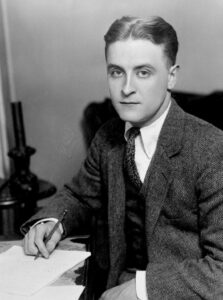
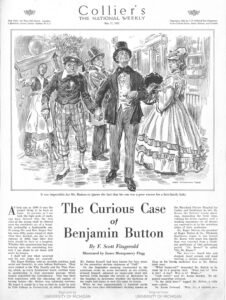
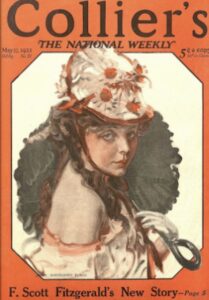
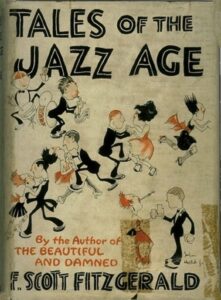
No one knows why, but it happened. One strange day in 1860, a baby is born already old — with sagging skin, a curved back, and hands deformed by arthritis. His eyes are dull, as if they’ve already seen too much. The doctors don’t understand, the family is ashamed, the town whispers. It isn’t a page from the newspaper, but the beginning of The Curious Case of Benjamin Button, the story F. Scott Fitzgerald wrote in 1922 for Collier’s magazine and later included in Tales of the Jazz Age. And yet, if we read it today — in a world that dissects every gene and every cell — it almost feels like a diagnosis. A clinical fairy tale, a poetic report on time rebelling against biology.
🕰️ Time in Reverse
Benjamin Button is born old, but strangely and inexplicably, he grows younger each passing day. So at fifty, in chronological age, he is a man in his prime; at eighty, he is an adolescent; and when he dies, he is a newborn who fades away in the nurse’s arms. It’s a reversed parabola — a life coiling back on itself like a spiral.
But beneath its surreal surface, Fitzgerald builds a crystal-clear reflection on the relationship between body and identity, on the fear of difference, and on that “genetic disease of time” that each of us carries within.
🩺 The Body as a Clinical Mystery
In the first half of the twentieth century, when Fitzgerald wrote the story, medicine was beginning to look at the human body through a modern lens: the first studies on endocrinology, Mendelian genetics gaining ground, the idea that aging could be “measured” and perhaps even controlled. In 1922, the dream of eternal youth was not just literary — it was a scientific temptation. Benjamin Button was born from that tension: an imaginary experiment, an “error” in the natural code. If we were to look for a parallel today, we would think immediately of progeria — those rare syndromes where DNA seems to accelerate time instead of containing it.
But Fitzgerald does not describe a sick child — he describes a judged one. Science, in his story, is powerless; medicine has no words to explain, and so prejudice takes over. His father, horrified, rejects him. He orders him to shave, to dress like a child, to pretend to be an age his body does not possess. From his first breath, Benjamin becomes a body incompatible with the world. And this is the clinical heart of the story: not the illness itself, but the collective reaction to a body that escapes the norm.
👁️ The Disease of Time
Every cell of the human body has its rhythm — biological clocks, telomeres, chronic inflammation, cellular senescence. Today we have the language to define what Fitzgerald, a hundred years ago, intuited as the pathology of time. Benjamin lives at odds with his own metabolism. His growth is not linear but regressive, creating a constant psychological short circuit: when the body is adult, the mind is young; when the mind is weary, the body is a child. It’s an existence without synchrony — as if body and mind were two instruments that can never tune to the same key.
Fitzgerald turns this anomaly into both a curse and a metaphor. Benjamin Button is not merely a “clinical case” — he is the ultimate symbol of human fragility in the face of time. He does not age; he heals himself to death. And in that biological paradox lies all the sadness of modern existence — the kind science can observe but never cure.
🧠 Identity, Stigma and the Social Gaze
One of the story’s most painful aspects is how others react to Benjamin’s body. The doctor measures him like a failed experiment; the father treats him as a disgrace; society looks on with a mix of curiosity and disgust. There is no physical violence — only the violence of the gaze, the kind well known to patients with rare diseases, visible syndromes, or conditions that make the body “foreign.” Fitzgerald’s story anticipates a question bioethics would explore decades later: Who decides what is normal? Benjamin does not suffer from his anomaly — he suffers from the loneliness it brings.
And as he grows younger, everyone else grows older and disappears: friends, wife, even his son — all slip away, leaving him increasingly alone in a body no one understands. That is the most striking point: illness is never purely biological. It is also social, relational, and narrative. Benjamin does not die of old age — he dies of incomprehension.
💉 Time as Diagnosis
Fitzgerald uses the language of a medical report right from the title: “The Curious Case of…” sounds like the heading of a clinical file. The story is written in a detached tone, almost like a case report: every stage of Benjamin’s life described as an evolution of symptoms. At the beginning: joint stiffness, premature beard, fatigue. In the middle: improvement, clarity, physical strength. At the end: memory loss, confusion, regression. A full cycle that reads more like an anamnesis than a fairy tale.
This stylistic choice is no accident: Fitzgerald turns life itself into an illness to be observed. Here, the boundary between literature and medicine becomes razor-thin: time becomes a pathogenic agent — a force that corrupts or, in Benjamin’s case, heals to the point of dissolution. Man is no longer sick with something — he is sick of time itself.
🌗 The Biology of Reversal
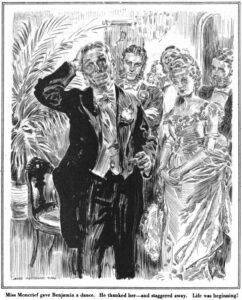
From a symbolic point of view, the reversal of the life cycle is also an experiment in perception: what happens when the human body stops obeying the direction of time? Fitzgerald’s answer is merciless: there can be no happiness in a life without direction. Benjamin cannot love freely, because his age never matches anyone else’s. He cannot belong to any phase of life, because whenever he arrives, he’s already too far ahead — or behind. A body out of time, a soul out of sync.
Here the story touches what we would now call identity dissonance: the distance between how we feel and how we appear, between biological and perceived age. Many people experience this — feeling older or younger than their body, living a biography that doesn’t match the chronology. Benjamin Button is the poetic exaggeration of this discrepancy: a syndrome of the soul, more than of DNA.
🧩 Childhood as a Return to the Unknown
The final part of the story is fiercely tender. Benjamin, now a child in body, has lost all memory of the world. His adoptive mother cares for him as for a newborn, but within him remains only a faint spark: he remembers nothing of who he was or what he lived. His rejuvenation coincides with the loss of identity — as if absolute youth were also a form of oblivion.
It’s an ending that overturns the myth of eternal youth: Fitzgerald seems to tell us that going backward is not rebirth — it is disappearance. If natural aging is a way of making peace with time, Benjamin’s regression is a way of getting lost within it. The eternally young man becomes a chronically pathological being — not free, but imprisoned in a cycle he cannot control.
🧬 Today: Science and the Dream of Anti-Aging
Rereading The Curious Case of Benjamin Button today feels almost unsettling. We live in an age obsessed with biological time, where the idea of reversing aging is no longer science fiction — it’s a frontier of research. And yet, Fitzgerald, a century ago, had already warned us: every time we challenge nature, we pay a price — the price of identity.
His story doesn’t demonize science; it reminds us that life is not a sequence of cells to be corrected, but a tapestry of experiences to be lived through. From this perspective, the progression of biological age — and the maturation of the body that comes with it — is not always an enemy. Sometimes, it is the only language through which we can learn to understand the law of time’s flow: always linear, never circular.
🕯️ The Story of a Collective Diagnosis
The strength of Benjamin Button lies in its apparent simplicity. It is a short, linear story, yet within it holds a universe of meanings: the fear of aging, the cult of youth, the loneliness of being different, the awareness (perhaps sometimes still hazy compared to reality) of science, and the tenderness of the absurd. It is a novella we can read as a collective diagnosis: each of us, in our own way, tries to reverse time — through medicine, memory, or the desire to never change.
And yet, it is precisely change that keeps us alive. Benjamin Button is born with the body of a man who has already lived many springs, and dies with the body of a newborn, yet the arc of his life is identical to ours: he is born, adapts, loves, suffers, forgets. Only he does it in reverse, as if Fitzgerald wanted us to see life from another perspective: birth as death, death as childhood.
🧠 The Perfect Error
The Curious Case of Benjamin Button is not a work of science fiction, nor a moral parable — it is an experiment in biological empathy. It forces us to look at anomaly not as monstrosity, but as a possibility of understanding. Fitzgerald doesn’t ask us to believe in Benjamin’s disease — he asks us to recognize it in ourselves.
Because everyone, in their own way, lives out of sync with their time — some too early, some too late, some mature without ever truly living. To tell the story of Benjamin Button today is to remember that:
science and literature are not separate worlds: one observes the body, the other listens to the soul. And sometimes, only together, can they tell the truth.
Samanta Sforna – All rights reserved.